PulseSure™ — Press One Button, Hear Your Reading In 20 Seconds Flat
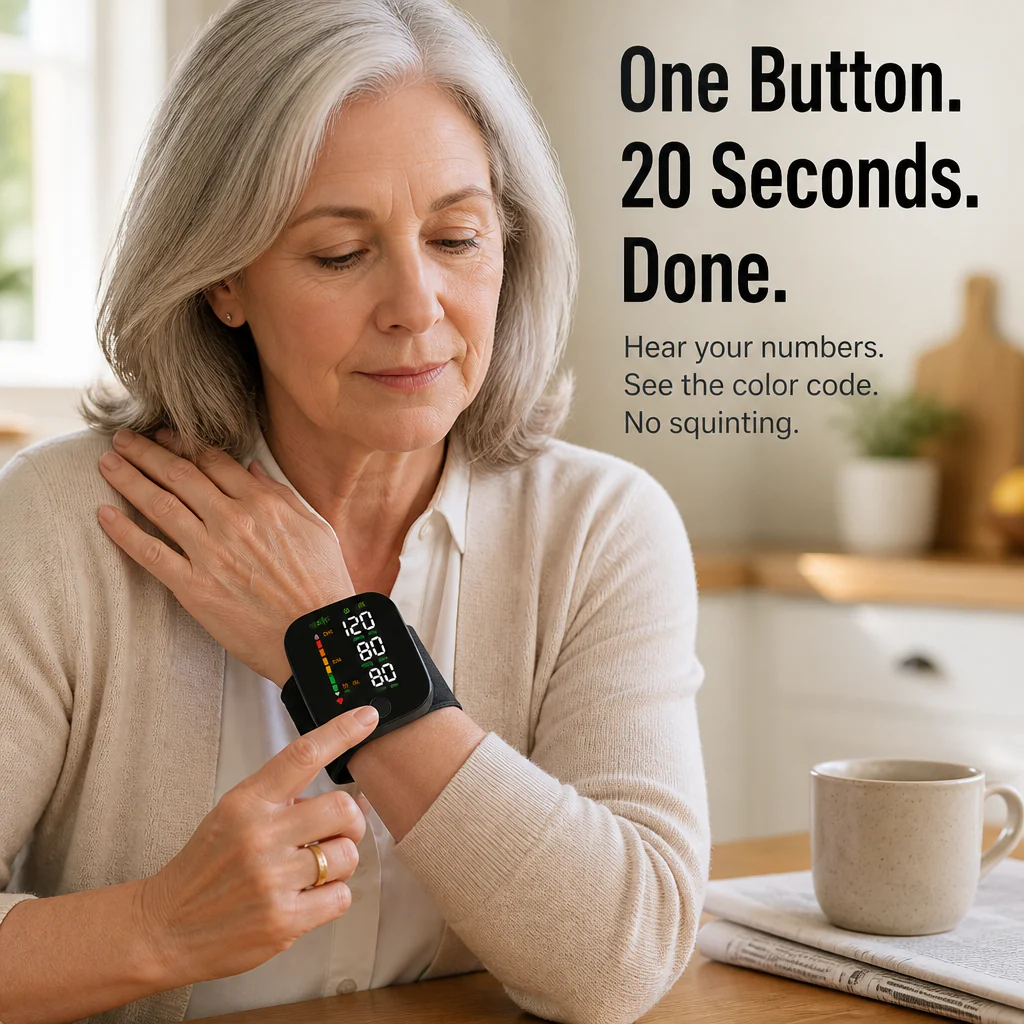
Press One Button. Hear Your Numbers. Done In 20 Seconds.
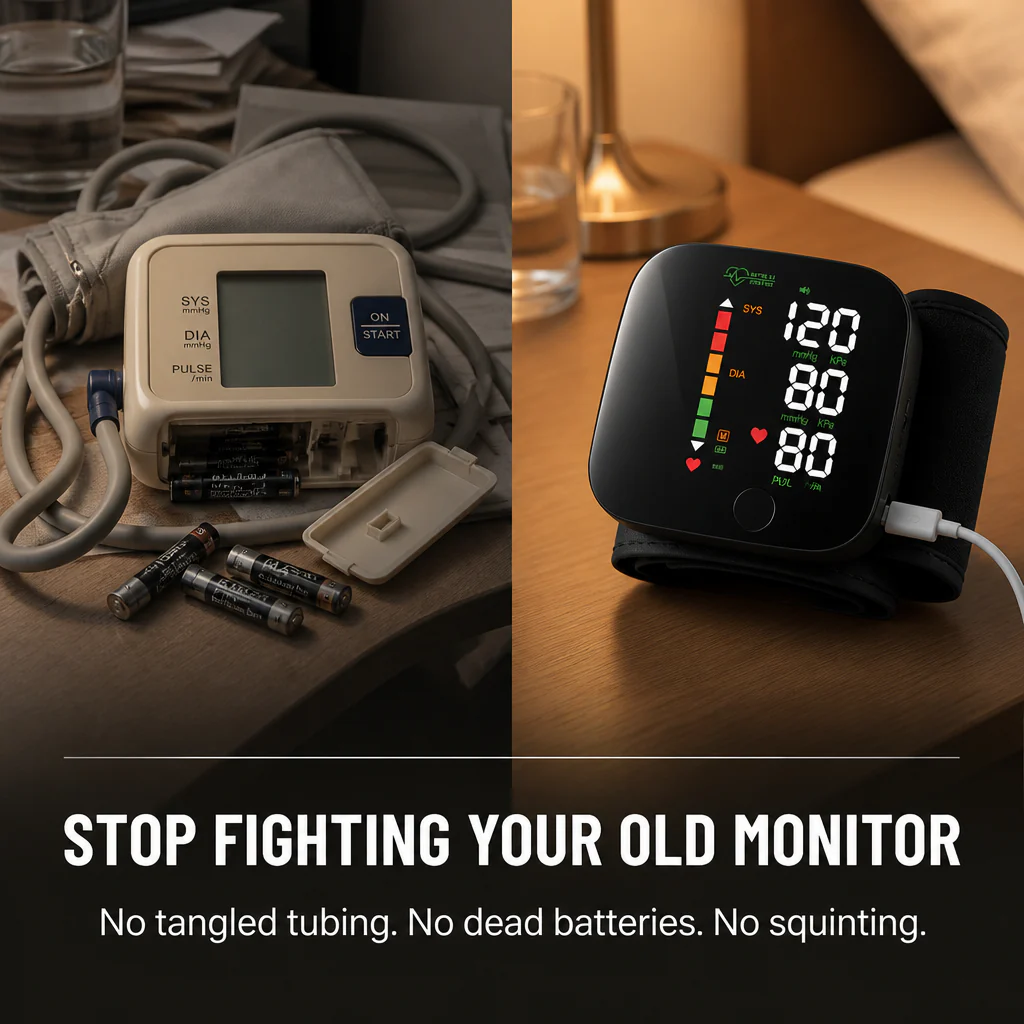
Checking your blood pressure shouldn't mean fighting an arm wrap, hunting for fresh AAAs, or squinting at a tiny grey screen. PulseSure™ wraps around your wrist, takes one button press, reads the numbers out loud, and lights up the LED bar green, yellow, or red — so you know exactly where you stand without needing to memorize what 138/87 means.

Tired of monitors built for someone half your age?
Most home monitors hide the real numbers behind a faded LCD and menus designed by engineers who never asked a single actual user. You shouldn't need to call your daughter on the phone to figure out which button does what. PulseSure™ has one button, one big LED screen, and a voice that reads your numbers back to you.
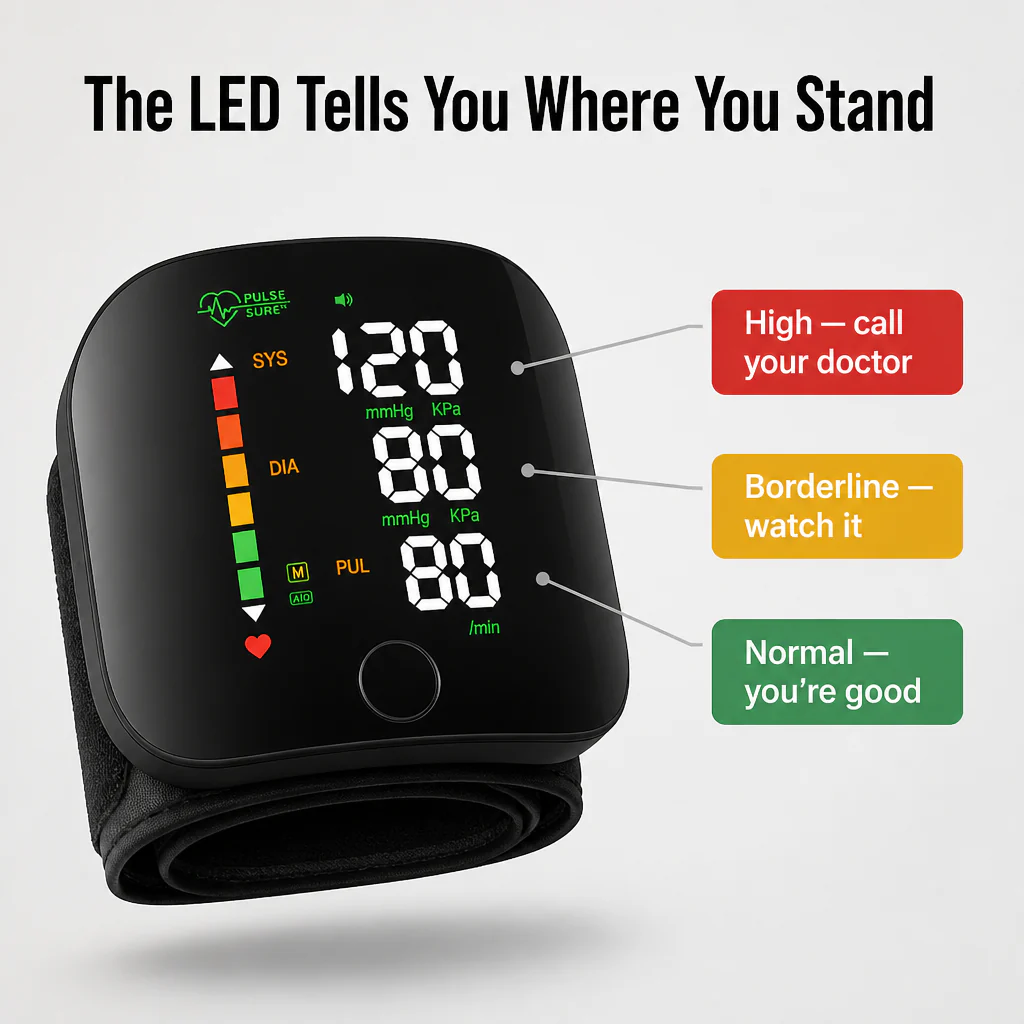
➤ Color-coded LED tells you instantly: Green means normal. Yellow means keep an eye on it. Red means call your doctor. No memorizing the cut-offs — the bar lights up the answer next to your reading.
➤ Big white numbers, lit-up screen, readable in any light: Bedside table at 3 a.m. or kitchen counter at noon — the LED backlight stays bright. If you can read a microwave clock, you can read this.
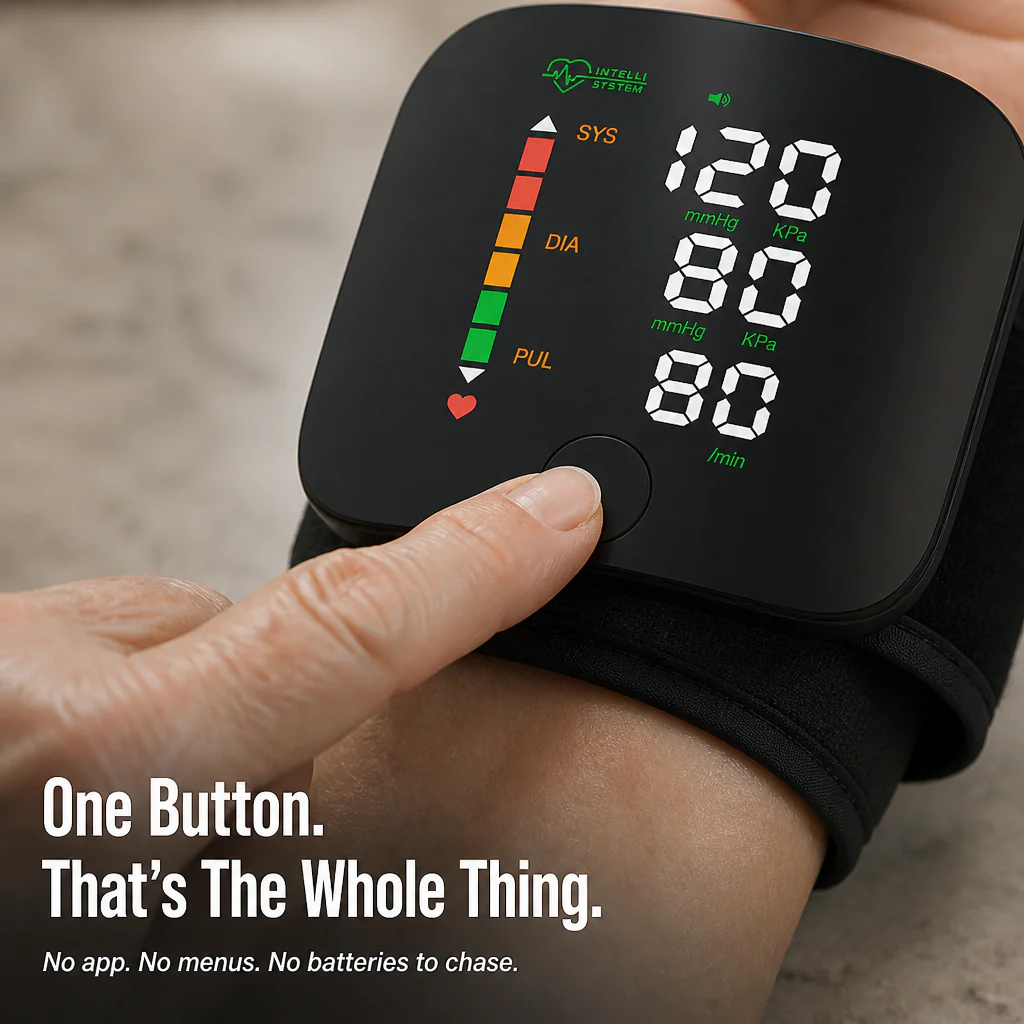
➤ One button, one job: Strap the cuff around your wrist, press the big silver button, and hold still. That's the whole process. No app, no menus, no batteries to swap out twice a year.

How PulseSure™ reads your blood pressure without an arm wrap
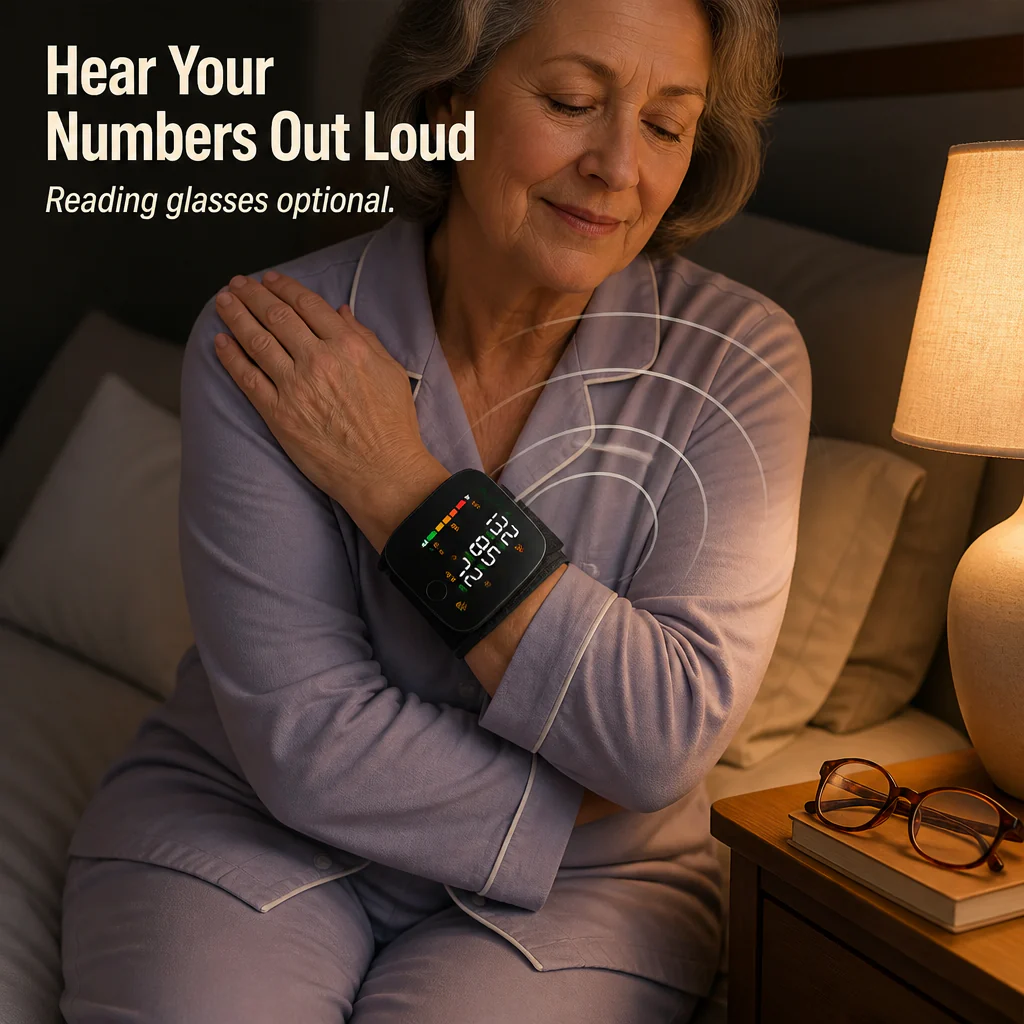
PulseSure™ uses a wrist cuff (fits 13.5–19.5 cm) with a built-in pressure sensor. Wrap it on, rest your hand on your opposite shoulder so the cuff sits level with your heart, and press the button. The cuff inflates, the sensor reads your pulse waveform, and the chip compares your systolic, diastolic, and pulse rate to the standard BP categories.
In under 20 seconds, the LED bar lights up green, yellow, or red — and the voice reads the numbers back to you so you don't have to squint at the screen and remember three figures at once. Each reading saves to memory, so when your doctor asks "how have your numbers been lately?" you have an actual log to show, not a guess.

Why people stopped fighting their old monitor and switched
Most of our buyers came over from an arm-wrap monitor that died, ate AAAs, or showed numbers too small to read without reading glasses. They wanted something they could keep on the nightstand, grab in five seconds, and check without asking for help.
"Bought this for my mum after her doctor told her to track at home. She had it figured out the first morning. The voice readout was the deciding factor — her eyesight isn't what it was." — Sarah K.
"I was skeptical because I'd heard wrist monitors weren't as accurate. I brought it to my next appointment and the nurse compared it against their machine — within 3 points. Good enough for me." — Robert M.

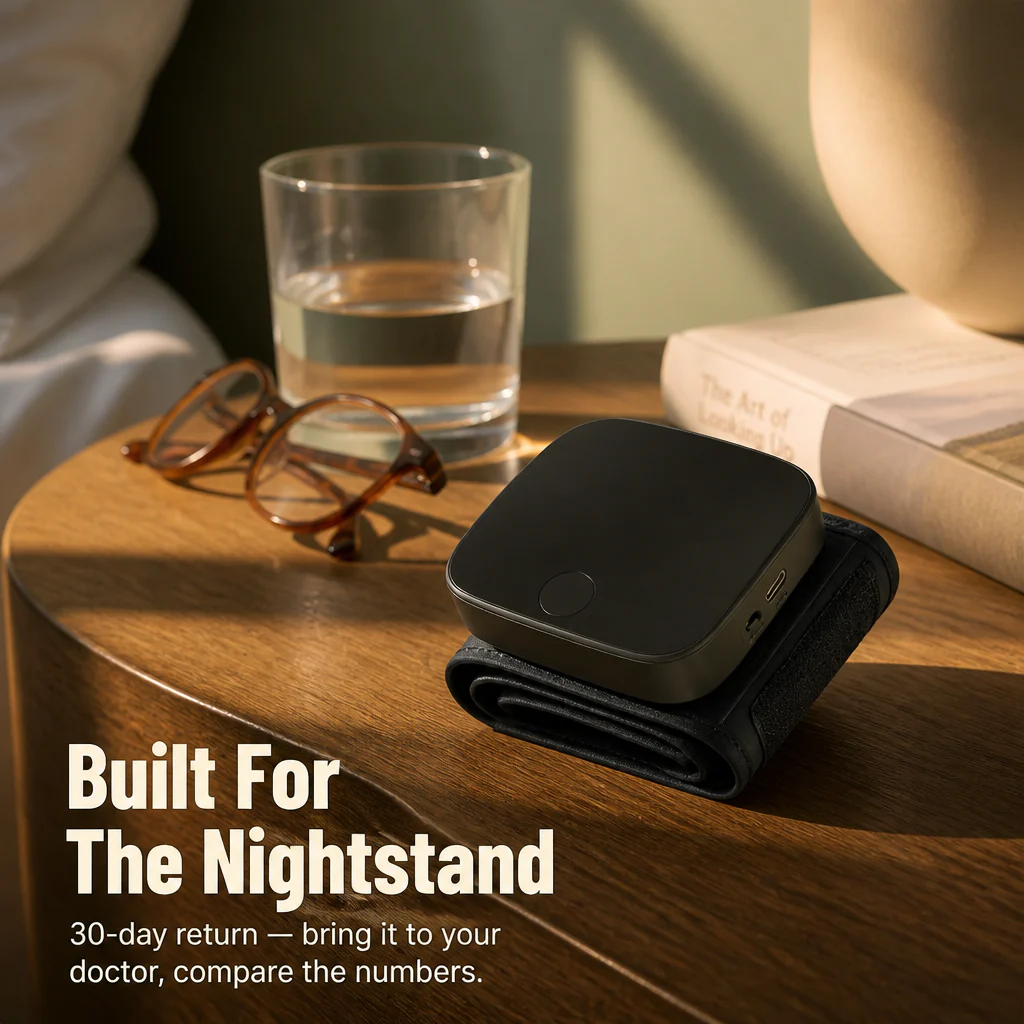
Built for the nightstand, the suitcase, and the kitchen drawer
✓ Catches irregular heartbeats automatically: A heart symbol blinks on screen the moment your pulse pattern goes off — so you can flag it at your next checkup instead of wondering about it later.
✓ Charges with the same cable as your phone: USB-C in. No specialty batteries to hunt down. One full charge runs dozens of readings before the next plug-in.
✓ Slips into a drawer or the included case: Compact enough to live in your nightstand or travel in a carry-on. No bulky arm cuff to coil up and store.
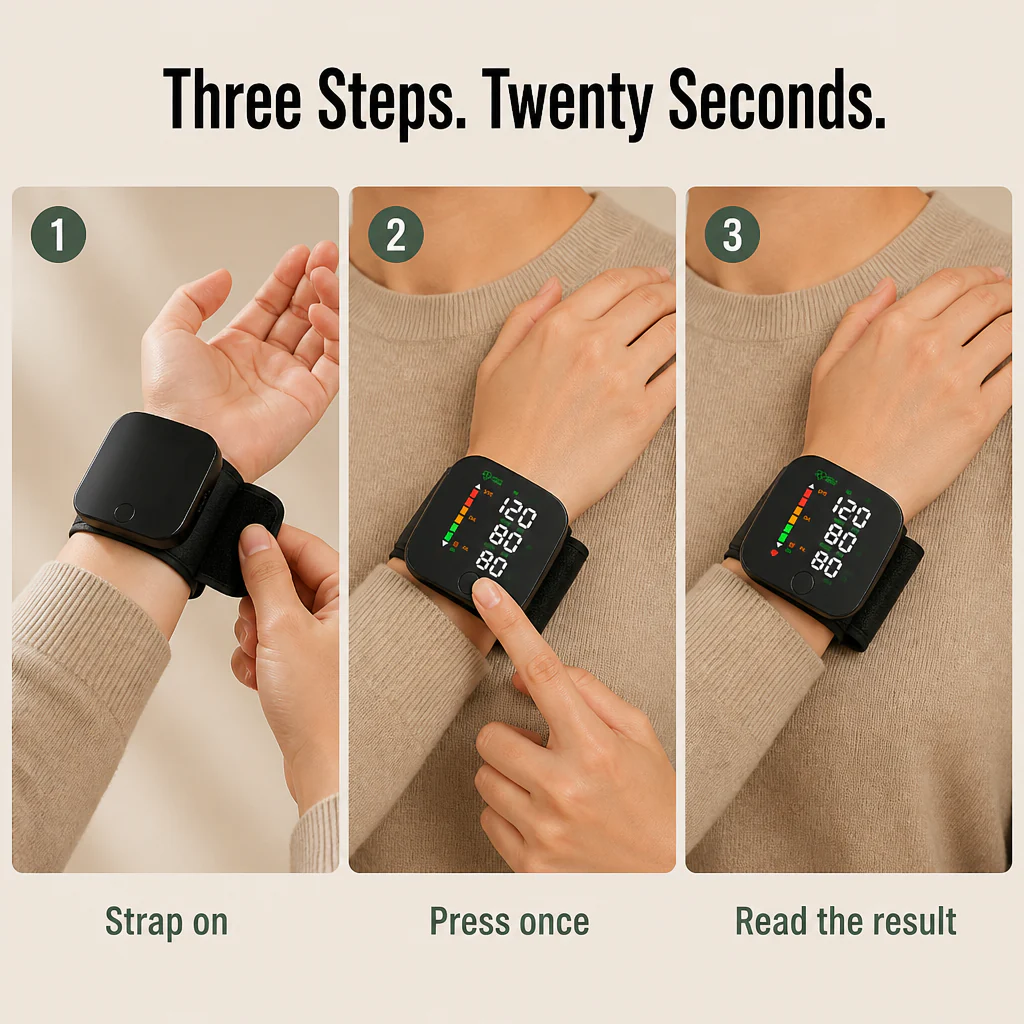
Take a reading in 3 steps — no manual required
Step 1: Wrap the cuff around your wrist with the screen facing up. Velcro it snug — about as tight as a watch band.
Step 2: Rest your hand on your opposite shoulder so the cuff sits at heart level, then press the big silver button once.
Step 3: Wait about 20 seconds. Hear your reading out loud. Glance at the color bar. Done.

| Benefit | PulseSure™ | Standard Wrist Monitors |
|---|---|---|
| Reading Time | ✅ Under 20 seconds, one-button start | ❌ 30–60 seconds, multi-step menus |
| Display & Risk Indicator | ✅ Bright LED with green/yellow/red color bar | ❌ Dim grey LCD, no risk indicator |
| Voice Readout | ✅ Reads your numbers out loud | ❌ Silent — squint to read |
| Power | ✅ USB-C rechargeable, dozens of readings per charge | ❌ Eats AAA batteries |
Specifications for those who demand the details
- Cuff fit: Wrist circumference 13.5–19.5 cm (adjustable Velcro band)
- Display: Backlit LED with color-coded risk bar (red / yellow / green)
- Voice readout: Audible playback of systolic, diastolic, and pulse
- Readings: SYS, DIA, PUL — in mmHg and KPa
- Memory: Stores recent readings for tracking over time
- Power: Rechargeable battery, USB-C charging
- Color: Matte black
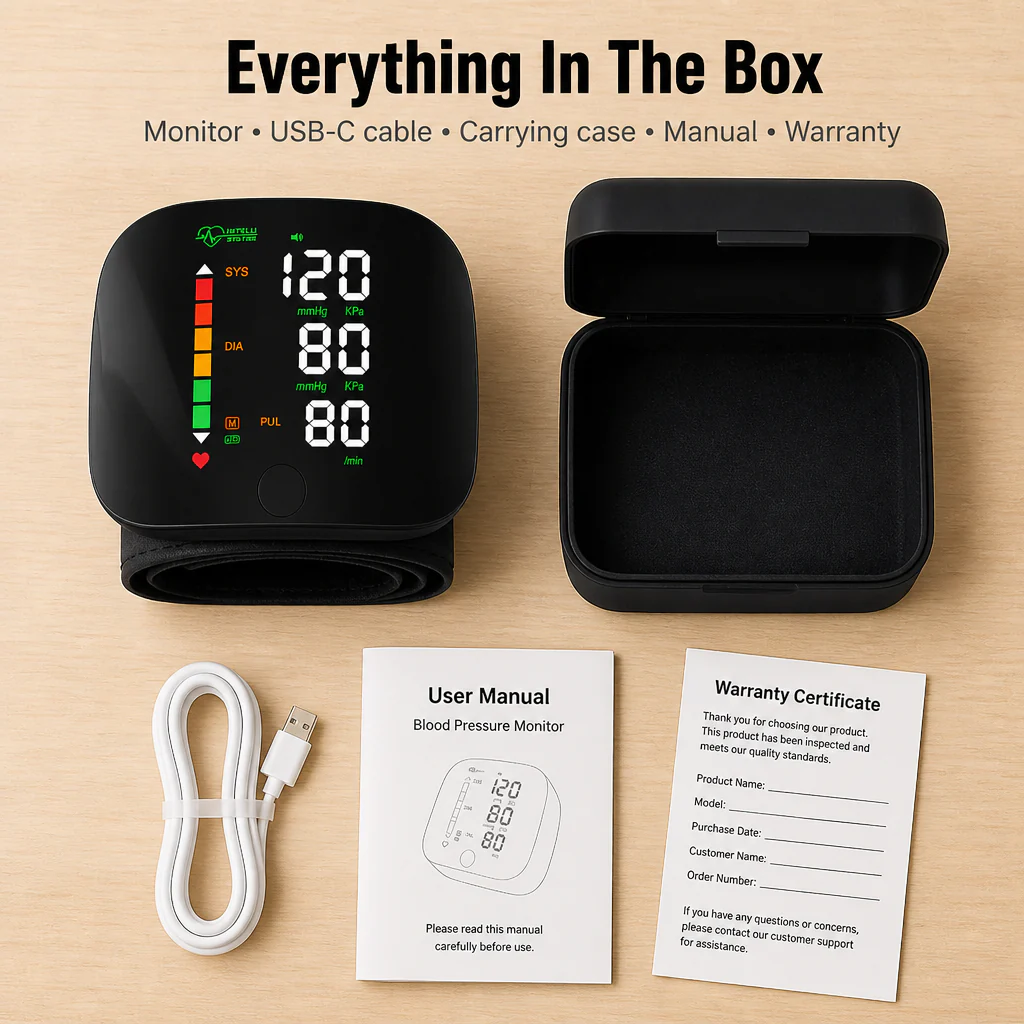
- In the box: Monitor, USB-C cable, carrying case, user manual, warranty certificate
Your Questions, Answered
Will the readings actually be accurate?
Wrist monitors are accurate when the cuff sits level with your heart — which is why we built the rest-your-hand-on-your-shoulder step into the instructions. For peace of mind, bring PulseSure™ to your next appointment and ask the nurse to compare against the clinic's monitor. Most users find them within a few points.
What if the cuff is too tight or too loose for me?
The Velcro band fits wrist circumferences from 13.5 to 19.5 cm — that covers most adult wrists. Snug-as-a-watch is the right tightness: tight enough to stay flat, loose enough to slip a finger underneath.
Is this easy enough for someone who hates tech?
One button. One screen. The voice reads your numbers out loud. If you can use a microwave, you can use PulseSure™ — no app, no setup, no menus to dig through.
How long does the charge last?
A full USB-C charge runs dozens of readings — most users plug in every few weeks, not every day. Same cable as a modern phone, so no extra charger to keep track of.
Does it catch irregular heartbeats?
Yes — PulseSure™ flags irregular pulse patterns automatically. A heart icon appears on the LED screen when it detects one, so you have something specific to mention at your next checkup.

Take it to your doctor. If the numbers don't match, send it back.
Try PulseSure™ for 30 days. Bring it to your next appointment and compare it against the clinic's monitor. If the readings don't line up — or PulseSure™ doesn't fit into your daily routine — send it back for a full refund. No questions about why.
Original: $39.99
-70%$39.99
$12.00More Images
PulseSure™ — Press One Button, Hear Your Reading In 20 Seconds Flat
Press One Button. Hear Your Numbers. Done In 20 Seconds.
Checking your blood pressure shouldn't mean fighting an arm wrap, hunting for fresh AAAs, or squinting at a tiny grey screen. PulseSure™ wraps around your wrist, takes one button press, reads the numbers out loud, and lights up the LED bar green, yellow, or red — so you know exactly where you stand without needing to memorize what 138/87 means.
Tired of monitors built for someone half your age?
Most home monitors hide the real numbers behind a faded LCD and menus designed by engineers who never asked a single actual user. You shouldn't need to call your daughter on the phone to figure out which button does what. PulseSure™ has one button, one big LED screen, and a voice that reads your numbers back to you.
➤ Color-coded LED tells you instantly: Green means normal. Yellow means keep an eye on it. Red means call your doctor. No memorizing the cut-offs — the bar lights up the answer next to your reading.
➤ Big white numbers, lit-up screen, readable in any light: Bedside table at 3 a.m. or kitchen counter at noon — the LED backlight stays bright. If you can read a microwave clock, you can read this.
➤ One button, one job: Strap the cuff around your wrist, press the big silver button, and hold still. That's the whole process. No app, no menus, no batteries to swap out twice a year.
How PulseSure™ reads your blood pressure without an arm wrap
PulseSure™ uses a wrist cuff (fits 13.5–19.5 cm) with a built-in pressure sensor. Wrap it on, rest your hand on your opposite shoulder so the cuff sits level with your heart, and press the button. The cuff inflates, the sensor reads your pulse waveform, and the chip compares your systolic, diastolic, and pulse rate to the standard BP categories.
In under 20 seconds, the LED bar lights up green, yellow, or red — and the voice reads the numbers back to you so you don't have to squint at the screen and remember three figures at once. Each reading saves to memory, so when your doctor asks "how have your numbers been lately?" you have an actual log to show, not a guess.
Why people stopped fighting their old monitor and switched
Most of our buyers came over from an arm-wrap monitor that died, ate AAAs, or showed numbers too small to read without reading glasses. They wanted something they could keep on the nightstand, grab in five seconds, and check without asking for help.
"Bought this for my mum after her doctor told her to track at home. She had it figured out the first morning. The voice readout was the deciding factor — her eyesight isn't what it was." — Sarah K.
"I was skeptical because I'd heard wrist monitors weren't as accurate. I brought it to my next appointment and the nurse compared it against their machine — within 3 points. Good enough for me." — Robert M.
Built for the nightstand, the suitcase, and the kitchen drawer
✓ Catches irregular heartbeats automatically: A heart symbol blinks on screen the moment your pulse pattern goes off — so you can flag it at your next checkup instead of wondering about it later.
✓ Charges with the same cable as your phone: USB-C in. No specialty batteries to hunt down. One full charge runs dozens of readings before the next plug-in.
✓ Slips into a drawer or the included case: Compact enough to live in your nightstand or travel in a carry-on. No bulky arm cuff to coil up and store.
Take a reading in 3 steps — no manual required
Step 1: Wrap the cuff around your wrist with the screen facing up. Velcro it snug — about as tight as a watch band.
Step 2: Rest your hand on your opposite shoulder so the cuff sits at heart level, then press the big silver button once.
Step 3: Wait about 20 seconds. Hear your reading out loud. Glance at the color bar. Done.
| Benefit | PulseSure™ | Standard Wrist Monitors |
|---|---|---|
| Reading Time | ✅ Under 20 seconds, one-button start | ❌ 30–60 seconds, multi-step menus |
| Display & Risk Indicator | ✅ Bright LED with green/yellow/red color bar | ❌ Dim grey LCD, no risk indicator |
| Voice Readout | ✅ Reads your numbers out loud | ❌ Silent — squint to read |
| Power | ✅ USB-C rechargeable, dozens of readings per charge | ❌ Eats AAA batteries |
Specifications for those who demand the details
- Cuff fit: Wrist circumference 13.5–19.5 cm (adjustable Velcro band)
- Display: Backlit LED with color-coded risk bar (red / yellow / green)
- Voice readout: Audible playback of systolic, diastolic, and pulse
- Readings: SYS, DIA, PUL — in mmHg and KPa
- Memory: Stores recent readings for tracking over time
- Power: Rechargeable battery, USB-C charging
- Color: Matte black
- In the box: Monitor, USB-C cable, carrying case, user manual, warranty certificate
Your Questions, Answered
Will the readings actually be accurate?
Wrist monitors are accurate when the cuff sits level with your heart — which is why we built the rest-your-hand-on-your-shoulder step into the instructions. For peace of mind, bring PulseSure™ to your next appointment and ask the nurse to compare against the clinic's monitor. Most users find them within a few points.
What if the cuff is too tight or too loose for me?
The Velcro band fits wrist circumferences from 13.5 to 19.5 cm — that covers most adult wrists. Snug-as-a-watch is the right tightness: tight enough to stay flat, loose enough to slip a finger underneath.
Is this easy enough for someone who hates tech?
One button. One screen. The voice reads your numbers out loud. If you can use a microwave, you can use PulseSure™ — no app, no setup, no menus to dig through.
How long does the charge last?
A full USB-C charge runs dozens of readings — most users plug in every few weeks, not every day. Same cable as a modern phone, so no extra charger to keep track of.
Does it catch irregular heartbeats?
Yes — PulseSure™ flags irregular pulse patterns automatically. A heart icon appears on the LED screen when it detects one, so you have something specific to mention at your next checkup.
Take it to your doctor. If the numbers don't match, send it back.
Try PulseSure™ for 30 days. Bring it to your next appointment and compare it against the clinic's monitor. If the readings don't line up — or PulseSure™ doesn't fit into your daily routine — send it back for a full refund. No questions about why.
Product Information
Product Information
Shipping & Returns
Shipping & Returns
Description
Press One Button. Hear Your Numbers. Done In 20 Seconds.
Checking your blood pressure shouldn't mean fighting an arm wrap, hunting for fresh AAAs, or squinting at a tiny grey screen. PulseSure™ wraps around your wrist, takes one button press, reads the numbers out loud, and lights up the LED bar green, yellow, or red — so you know exactly where you stand without needing to memorize what 138/87 means.
Tired of monitors built for someone half your age?
Most home monitors hide the real numbers behind a faded LCD and menus designed by engineers who never asked a single actual user. You shouldn't need to call your daughter on the phone to figure out which button does what. PulseSure™ has one button, one big LED screen, and a voice that reads your numbers back to you.
➤ Color-coded LED tells you instantly: Green means normal. Yellow means keep an eye on it. Red means call your doctor. No memorizing the cut-offs — the bar lights up the answer next to your reading.
➤ Big white numbers, lit-up screen, readable in any light: Bedside table at 3 a.m. or kitchen counter at noon — the LED backlight stays bright. If you can read a microwave clock, you can read this.
➤ One button, one job: Strap the cuff around your wrist, press the big silver button, and hold still. That's the whole process. No app, no menus, no batteries to swap out twice a year.
How PulseSure™ reads your blood pressure without an arm wrap
PulseSure™ uses a wrist cuff (fits 13.5–19.5 cm) with a built-in pressure sensor. Wrap it on, rest your hand on your opposite shoulder so the cuff sits level with your heart, and press the button. The cuff inflates, the sensor reads your pulse waveform, and the chip compares your systolic, diastolic, and pulse rate to the standard BP categories.
In under 20 seconds, the LED bar lights up green, yellow, or red — and the voice reads the numbers back to you so you don't have to squint at the screen and remember three figures at once. Each reading saves to memory, so when your doctor asks "how have your numbers been lately?" you have an actual log to show, not a guess.
Why people stopped fighting their old monitor and switched
Most of our buyers came over from an arm-wrap monitor that died, ate AAAs, or showed numbers too small to read without reading glasses. They wanted something they could keep on the nightstand, grab in five seconds, and check without asking for help.
"Bought this for my mum after her doctor told her to track at home. She had it figured out the first morning. The voice readout was the deciding factor — her eyesight isn't what it was." — Sarah K.
"I was skeptical because I'd heard wrist monitors weren't as accurate. I brought it to my next appointment and the nurse compared it against their machine — within 3 points. Good enough for me." — Robert M.
Built for the nightstand, the suitcase, and the kitchen drawer
✓ Catches irregular heartbeats automatically: A heart symbol blinks on screen the moment your pulse pattern goes off — so you can flag it at your next checkup instead of wondering about it later.
✓ Charges with the same cable as your phone: USB-C in. No specialty batteries to hunt down. One full charge runs dozens of readings before the next plug-in.
✓ Slips into a drawer or the included case: Compact enough to live in your nightstand or travel in a carry-on. No bulky arm cuff to coil up and store.
Take a reading in 3 steps — no manual required
Step 1: Wrap the cuff around your wrist with the screen facing up. Velcro it snug — about as tight as a watch band.
Step 2: Rest your hand on your opposite shoulder so the cuff sits at heart level, then press the big silver button once.
Step 3: Wait about 20 seconds. Hear your reading out loud. Glance at the color bar. Done.
| Benefit | PulseSure™ | Standard Wrist Monitors |
|---|---|---|
| Reading Time | ✅ Under 20 seconds, one-button start | ❌ 30–60 seconds, multi-step menus |
| Display & Risk Indicator | ✅ Bright LED with green/yellow/red color bar | ❌ Dim grey LCD, no risk indicator |
| Voice Readout | ✅ Reads your numbers out loud | ❌ Silent — squint to read |
| Power | ✅ USB-C rechargeable, dozens of readings per charge | ❌ Eats AAA batteries |
Specifications for those who demand the details
- Cuff fit: Wrist circumference 13.5–19.5 cm (adjustable Velcro band)
- Display: Backlit LED with color-coded risk bar (red / yellow / green)
- Voice readout: Audible playback of systolic, diastolic, and pulse
- Readings: SYS, DIA, PUL — in mmHg and KPa
- Memory: Stores recent readings for tracking over time
- Power: Rechargeable battery, USB-C charging
- Color: Matte black
- In the box: Monitor, USB-C cable, carrying case, user manual, warranty certificate
Your Questions, Answered
Will the readings actually be accurate?
Wrist monitors are accurate when the cuff sits level with your heart — which is why we built the rest-your-hand-on-your-shoulder step into the instructions. For peace of mind, bring PulseSure™ to your next appointment and ask the nurse to compare against the clinic's monitor. Most users find them within a few points.
What if the cuff is too tight or too loose for me?
The Velcro band fits wrist circumferences from 13.5 to 19.5 cm — that covers most adult wrists. Snug-as-a-watch is the right tightness: tight enough to stay flat, loose enough to slip a finger underneath.
Is this easy enough for someone who hates tech?
One button. One screen. The voice reads your numbers out loud. If you can use a microwave, you can use PulseSure™ — no app, no setup, no menus to dig through.
How long does the charge last?
A full USB-C charge runs dozens of readings — most users plug in every few weeks, not every day. Same cable as a modern phone, so no extra charger to keep track of.
Does it catch irregular heartbeats?
Yes — PulseSure™ flags irregular pulse patterns automatically. A heart icon appears on the LED screen when it detects one, so you have something specific to mention at your next checkup.
Take it to your doctor. If the numbers don't match, send it back.
Try PulseSure™ for 30 days. Bring it to your next appointment and compare it against the clinic's monitor. If the readings don't line up — or PulseSure™ doesn't fit into your daily routine — send it back for a full refund. No questions about why.