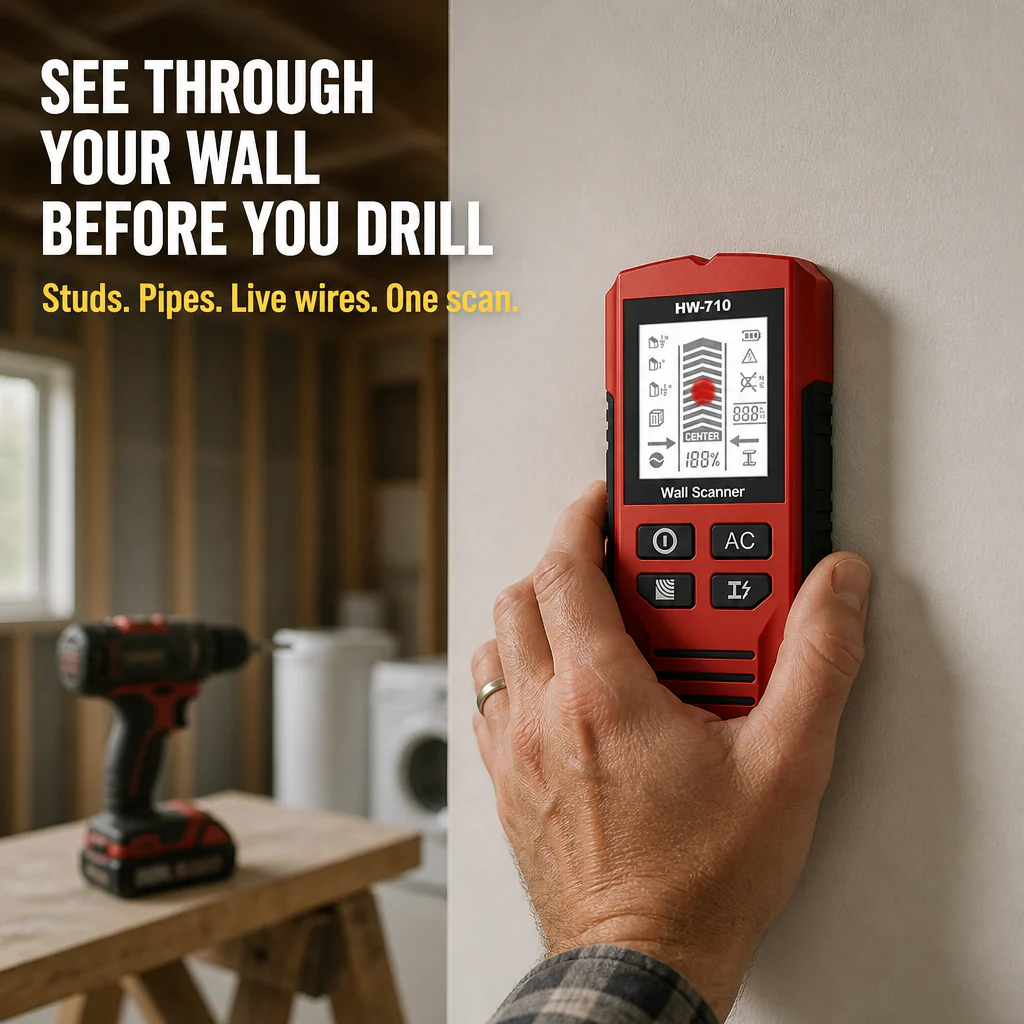
WallSight™ — Spot Studs, Pipes & Live Wires Before You Drill
Stop Drilling and Hoping You Don't Hit Something
One mis-aimed hole and you're patching drywall, calling a plumber, or worse — staring at a sparking wire behind your TV bracket. The HW-710 Wall Scanner shows you exactly where studs, copper pipes, and live AC wires are hiding before the drill bit touches the wall. Five scan modes. One clear LCD readout. Zero guesswork.

The Cheap Magnetic Stud Finder Lies to You
Magnet-based finders only catch the nails — and they miss half the time on plaster. You end up knocking on the wall like grandpa did, drilling three test holes before you find a joist, then hanging the shelf and crossing your fingers. One bad hole later you're $400 in for a pipe repair you didn't budget for. The HW-710 takes the guessing out of the equation.

Built for the Three Things You Actually Need to Find
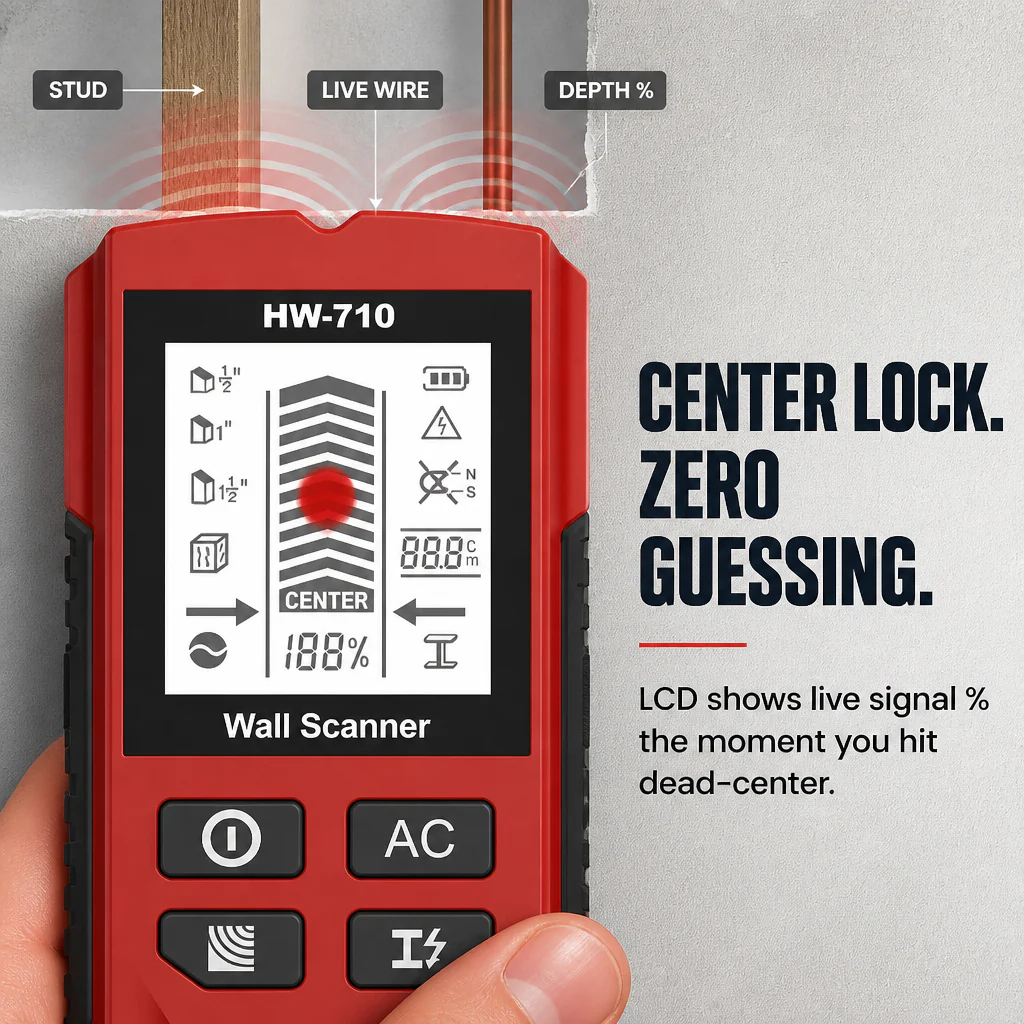
➤ Locks Onto Wood Studs Down to 1½" Deep: Three depth modes — ½", 1", and 1½" — find joists behind thick plaster, double drywall, or paneling without the false pings a basic finder gives you.
➤ Catches Live AC Wires Before the Drill Does: A dedicated AC mode flashes the warning icon and fires the audio alarm the second the scanner senses current. The live wire stays the electrician's problem, not yours.
➤ Sees Copper Pipes and Rebar in Concrete: Metal mode reads both ferrous (steel rebar) and non-ferrous (copper plumbing) up to 38 mm deep — the two things that turn a quick TV mount into a weekend at the hardware store.

How the HW-710 Actually Sees Through Your Wall
Inside the housing is a wideband sensor array that reads density and electromagnetic changes through drywall, plaster, and concrete. As you slide the scanner across the surface, the LCD shows a live signal bar that fills as you approach an object — then snaps to CENTER with a red dot the moment you're dead-on. A percentage readout tells you how close you are to the true center of the stud, so you mark the spot once and drill clean.
It auto-calibrates the second you power it on against the wall. No twisting, no recalibrating every two feet, no waiting for an LED to "settle." Hit the button, slide, mark.

Why DIY Homeowners and Trade Guys Both Reach for It
"I almost drilled into a hot wire last summer hanging a bathroom mirror. Bought a $15 stud finder afterward — it was worthless on old plaster. This one actually pings the AC line and the alarm is loud enough to hear over the radio. Found three pipes I had no idea were back there before I started the backsplash." — Daniel R.
"I'm a finish carpenter. I keep one in the truck for the awkward jobs where a magnet finder won't catch anything. The depth modes are the part the $20 ones don't have. Worth it." — Hector M.
What You Actually Get
✓ Find the stud on the first scan, not the third.
✓ Spot live wires before the drill bit does.
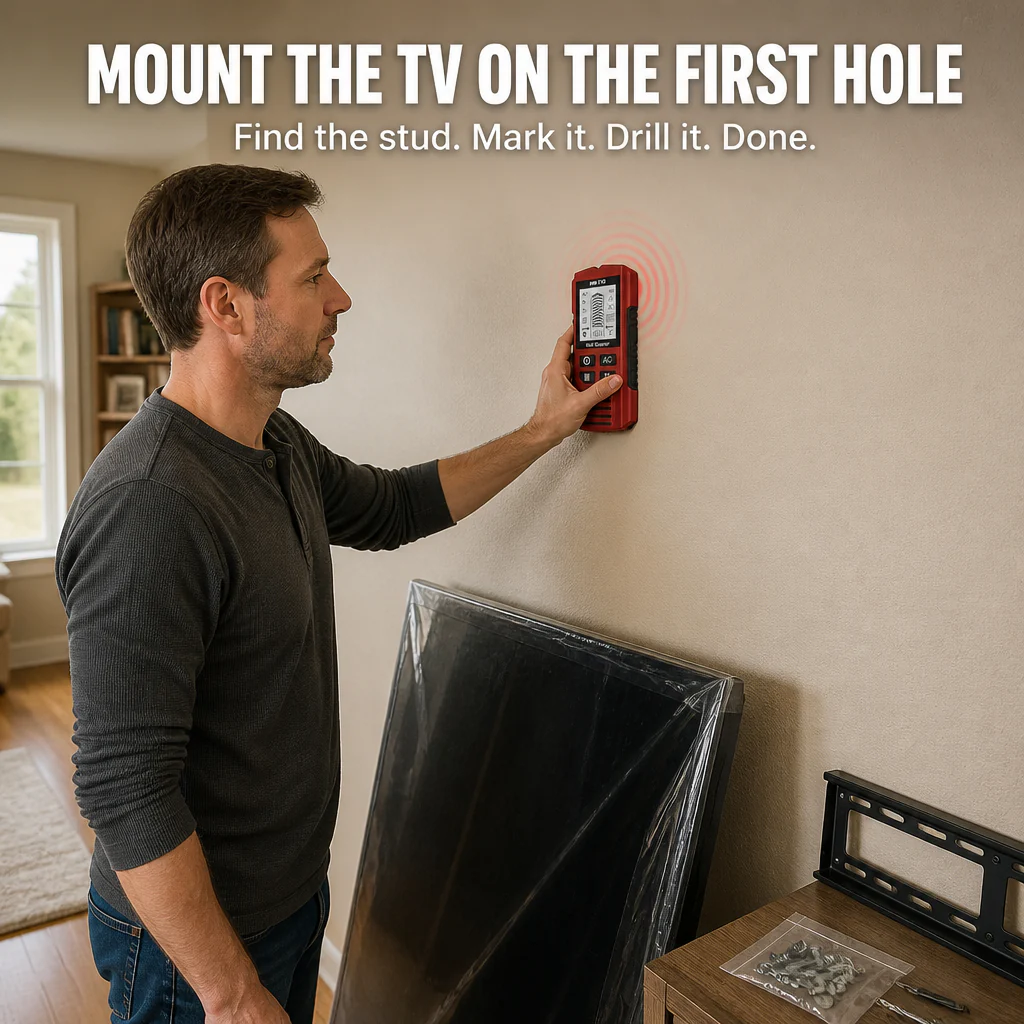
✓ Mount heavy TVs, shelves, and cabinets without a callback.
Three Steps to a Clean Hole, Every Time
1. Power on with the scanner held flat against the wall — auto-calibration takes one second.
2. Press the mode you need: stud depth, AC, or metal. The mode icon lights up on the LCD.
3. Slide horizontally. When the signal bar fills and the CENTER lock fires (red dot + audio alarm), mark the spot and drill.

How It Stacks Up
| Feature | HW-710 Wall Scanner | Cheap Magnetic Stud Finder | Knock-and-Pray |
|---|---|---|---|
| Finds wood studs | Yes, up to 1½" deep | Only if a nail is near the surface | Sometimes |
| Detects live AC wiring | Yes, audio + LCD alarm | No | No |
| Spots metal pipes & rebar | Yes, up to 38 mm | No | No |
| Center-lock readout | LCD with depth % | Blinking LED at best | None |
| Works on plaster & concrete | Yes | Hit or miss | No |
Specs at a Glance
- Model: HW-710
- Scan modes: 5 (½" stud / 1" stud / 1½" stud / metal / AC)
- Max metal scan depth: ~38 mm (1.5")
- Max AC scan depth: ~51 mm (2")
- Display: LCD with center indicator, signal bar, depth %, mode icons
- Audio alarm: built-in, sounds at center-lock
- Buttons: 4 sealed tactile (Power/Stud, AC, Metal, Deep Metal)
- Housing: shock-absorbent shell with non-marring rear pads
- Dimensions: 15 × 6.7 × 3 cm (5.9 × 2.6 × 1.2 in)
- Power: battery-operated, low-battery indicator on display
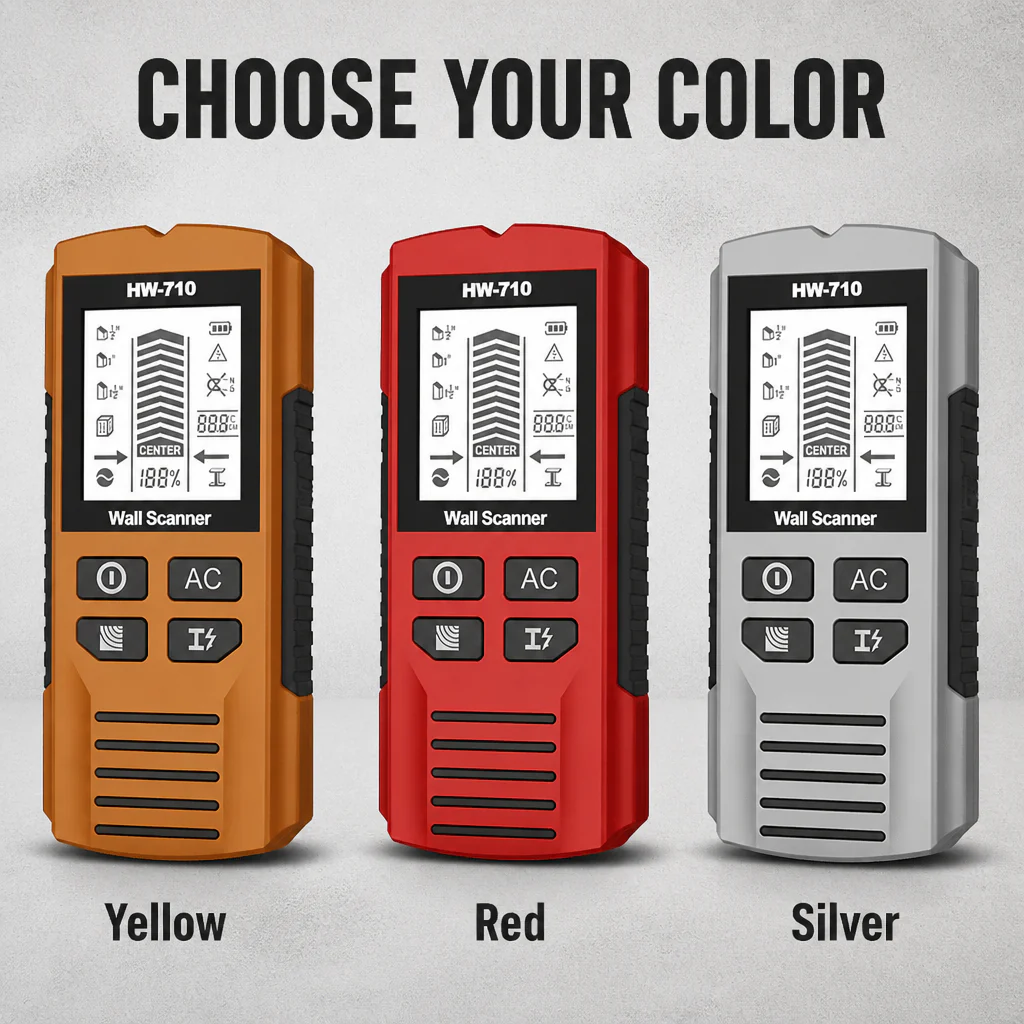
- Colors: Yellow, Red, Silver
Quick Answers
Will it work on plaster or lath walls?
Yes — the 1½" stud mode is built specifically for thicker plaster and double drywall. Skip the ½" mode for those walls; it's tuned for thin surfaces.
How accurate is the live wire detection?
The AC mode reads currents in standard household wiring through drywall up to about 51 mm deep. Treat it as a safety check that backs up shutting off the breaker — not a replacement for it.
Does it need recalibrating every time I move it?
No. It auto-calibrates the moment you power it on against the wall. Slide horizontally and scan — no twisting, no resetting between passes.
Will it scratch my freshly painted wall?
The rear pads are soft and non-marring. Slide it lightly, don't press it. No marks on satin or eggshell paint.
What batteries does it run on?
It runs on standard battery power with a low-battery icon at the top of the LCD. Batteries aren't always included — check the box on arrival.

Drill Safe — Or Get Your Money Back
If the HW-710 doesn't find what's hiding behind your wall on the first scan, send it back within 30 days for a full refund. The bracket gets hung. The pipe stays intact. Or the scanner doesn't cost you a dime.
Original: $29.99
-70%$29.99
$9.00More Images




WallSight™ — Spot Studs, Pipes & Live Wires Before You Drill
Stop Drilling and Hoping You Don't Hit Something
One mis-aimed hole and you're patching drywall, calling a plumber, or worse — staring at a sparking wire behind your TV bracket. The HW-710 Wall Scanner shows you exactly where studs, copper pipes, and live AC wires are hiding before the drill bit touches the wall. Five scan modes. One clear LCD readout. Zero guesswork.
The Cheap Magnetic Stud Finder Lies to You
Magnet-based finders only catch the nails — and they miss half the time on plaster. You end up knocking on the wall like grandpa did, drilling three test holes before you find a joist, then hanging the shelf and crossing your fingers. One bad hole later you're $400 in for a pipe repair you didn't budget for. The HW-710 takes the guessing out of the equation.
Built for the Three Things You Actually Need to Find
➤ Locks Onto Wood Studs Down to 1½" Deep: Three depth modes — ½", 1", and 1½" — find joists behind thick plaster, double drywall, or paneling without the false pings a basic finder gives you.
➤ Catches Live AC Wires Before the Drill Does: A dedicated AC mode flashes the warning icon and fires the audio alarm the second the scanner senses current. The live wire stays the electrician's problem, not yours.
➤ Sees Copper Pipes and Rebar in Concrete: Metal mode reads both ferrous (steel rebar) and non-ferrous (copper plumbing) up to 38 mm deep — the two things that turn a quick TV mount into a weekend at the hardware store.
How the HW-710 Actually Sees Through Your Wall
Inside the housing is a wideband sensor array that reads density and electromagnetic changes through drywall, plaster, and concrete. As you slide the scanner across the surface, the LCD shows a live signal bar that fills as you approach an object — then snaps to CENTER with a red dot the moment you're dead-on. A percentage readout tells you how close you are to the true center of the stud, so you mark the spot once and drill clean.
It auto-calibrates the second you power it on against the wall. No twisting, no recalibrating every two feet, no waiting for an LED to "settle." Hit the button, slide, mark.
Why DIY Homeowners and Trade Guys Both Reach for It
"I almost drilled into a hot wire last summer hanging a bathroom mirror. Bought a $15 stud finder afterward — it was worthless on old plaster. This one actually pings the AC line and the alarm is loud enough to hear over the radio. Found three pipes I had no idea were back there before I started the backsplash." — Daniel R.
"I'm a finish carpenter. I keep one in the truck for the awkward jobs where a magnet finder won't catch anything. The depth modes are the part the $20 ones don't have. Worth it." — Hector M.
What You Actually Get
✓ Find the stud on the first scan, not the third.
✓ Spot live wires before the drill bit does.
✓ Mount heavy TVs, shelves, and cabinets without a callback.
Three Steps to a Clean Hole, Every Time
1. Power on with the scanner held flat against the wall — auto-calibration takes one second.
2. Press the mode you need: stud depth, AC, or metal. The mode icon lights up on the LCD.
3. Slide horizontally. When the signal bar fills and the CENTER lock fires (red dot + audio alarm), mark the spot and drill.
How It Stacks Up
| Feature | HW-710 Wall Scanner | Cheap Magnetic Stud Finder | Knock-and-Pray |
|---|---|---|---|
| Finds wood studs | Yes, up to 1½" deep | Only if a nail is near the surface | Sometimes |
| Detects live AC wiring | Yes, audio + LCD alarm | No | No |
| Spots metal pipes & rebar | Yes, up to 38 mm | No | No |
| Center-lock readout | LCD with depth % | Blinking LED at best | None |
| Works on plaster & concrete | Yes | Hit or miss | No |
Specs at a Glance
- Model: HW-710
- Scan modes: 5 (½" stud / 1" stud / 1½" stud / metal / AC)
- Max metal scan depth: ~38 mm (1.5")
- Max AC scan depth: ~51 mm (2")
- Display: LCD with center indicator, signal bar, depth %, mode icons
- Audio alarm: built-in, sounds at center-lock
- Buttons: 4 sealed tactile (Power/Stud, AC, Metal, Deep Metal)
- Housing: shock-absorbent shell with non-marring rear pads
- Dimensions: 15 × 6.7 × 3 cm (5.9 × 2.6 × 1.2 in)
- Power: battery-operated, low-battery indicator on display
- Colors: Yellow, Red, Silver
Quick Answers
Will it work on plaster or lath walls?
Yes — the 1½" stud mode is built specifically for thicker plaster and double drywall. Skip the ½" mode for those walls; it's tuned for thin surfaces.
How accurate is the live wire detection?
The AC mode reads currents in standard household wiring through drywall up to about 51 mm deep. Treat it as a safety check that backs up shutting off the breaker — not a replacement for it.
Does it need recalibrating every time I move it?
No. It auto-calibrates the moment you power it on against the wall. Slide horizontally and scan — no twisting, no resetting between passes.
Will it scratch my freshly painted wall?
The rear pads are soft and non-marring. Slide it lightly, don't press it. No marks on satin or eggshell paint.
What batteries does it run on?
It runs on standard battery power with a low-battery icon at the top of the LCD. Batteries aren't always included — check the box on arrival.
Drill Safe — Or Get Your Money Back
If the HW-710 doesn't find what's hiding behind your wall on the first scan, send it back within 30 days for a full refund. The bracket gets hung. The pipe stays intact. Or the scanner doesn't cost you a dime.
Product Information
Product Information
Shipping & Returns
Shipping & Returns
Description
Stop Drilling and Hoping You Don't Hit Something
One mis-aimed hole and you're patching drywall, calling a plumber, or worse — staring at a sparking wire behind your TV bracket. The HW-710 Wall Scanner shows you exactly where studs, copper pipes, and live AC wires are hiding before the drill bit touches the wall. Five scan modes. One clear LCD readout. Zero guesswork.
The Cheap Magnetic Stud Finder Lies to You
Magnet-based finders only catch the nails — and they miss half the time on plaster. You end up knocking on the wall like grandpa did, drilling three test holes before you find a joist, then hanging the shelf and crossing your fingers. One bad hole later you're $400 in for a pipe repair you didn't budget for. The HW-710 takes the guessing out of the equation.
Built for the Three Things You Actually Need to Find
➤ Locks Onto Wood Studs Down to 1½" Deep: Three depth modes — ½", 1", and 1½" — find joists behind thick plaster, double drywall, or paneling without the false pings a basic finder gives you.
➤ Catches Live AC Wires Before the Drill Does: A dedicated AC mode flashes the warning icon and fires the audio alarm the second the scanner senses current. The live wire stays the electrician's problem, not yours.
➤ Sees Copper Pipes and Rebar in Concrete: Metal mode reads both ferrous (steel rebar) and non-ferrous (copper plumbing) up to 38 mm deep — the two things that turn a quick TV mount into a weekend at the hardware store.
How the HW-710 Actually Sees Through Your Wall
Inside the housing is a wideband sensor array that reads density and electromagnetic changes through drywall, plaster, and concrete. As you slide the scanner across the surface, the LCD shows a live signal bar that fills as you approach an object — then snaps to CENTER with a red dot the moment you're dead-on. A percentage readout tells you how close you are to the true center of the stud, so you mark the spot once and drill clean.
It auto-calibrates the second you power it on against the wall. No twisting, no recalibrating every two feet, no waiting for an LED to "settle." Hit the button, slide, mark.
Why DIY Homeowners and Trade Guys Both Reach for It
"I almost drilled into a hot wire last summer hanging a bathroom mirror. Bought a $15 stud finder afterward — it was worthless on old plaster. This one actually pings the AC line and the alarm is loud enough to hear over the radio. Found three pipes I had no idea were back there before I started the backsplash." — Daniel R.
"I'm a finish carpenter. I keep one in the truck for the awkward jobs where a magnet finder won't catch anything. The depth modes are the part the $20 ones don't have. Worth it." — Hector M.
What You Actually Get
✓ Find the stud on the first scan, not the third.
✓ Spot live wires before the drill bit does.
✓ Mount heavy TVs, shelves, and cabinets without a callback.
Three Steps to a Clean Hole, Every Time
1. Power on with the scanner held flat against the wall — auto-calibration takes one second.
2. Press the mode you need: stud depth, AC, or metal. The mode icon lights up on the LCD.
3. Slide horizontally. When the signal bar fills and the CENTER lock fires (red dot + audio alarm), mark the spot and drill.
How It Stacks Up
| Feature | HW-710 Wall Scanner | Cheap Magnetic Stud Finder | Knock-and-Pray |
|---|---|---|---|
| Finds wood studs | Yes, up to 1½" deep | Only if a nail is near the surface | Sometimes |
| Detects live AC wiring | Yes, audio + LCD alarm | No | No |
| Spots metal pipes & rebar | Yes, up to 38 mm | No | No |
| Center-lock readout | LCD with depth % | Blinking LED at best | None |
| Works on plaster & concrete | Yes | Hit or miss | No |
Specs at a Glance
- Model: HW-710
- Scan modes: 5 (½" stud / 1" stud / 1½" stud / metal / AC)
- Max metal scan depth: ~38 mm (1.5")
- Max AC scan depth: ~51 mm (2")
- Display: LCD with center indicator, signal bar, depth %, mode icons
- Audio alarm: built-in, sounds at center-lock
- Buttons: 4 sealed tactile (Power/Stud, AC, Metal, Deep Metal)
- Housing: shock-absorbent shell with non-marring rear pads
- Dimensions: 15 × 6.7 × 3 cm (5.9 × 2.6 × 1.2 in)
- Power: battery-operated, low-battery indicator on display
- Colors: Yellow, Red, Silver
Quick Answers
Will it work on plaster or lath walls?
Yes — the 1½" stud mode is built specifically for thicker plaster and double drywall. Skip the ½" mode for those walls; it's tuned for thin surfaces.
How accurate is the live wire detection?
The AC mode reads currents in standard household wiring through drywall up to about 51 mm deep. Treat it as a safety check that backs up shutting off the breaker — not a replacement for it.
Does it need recalibrating every time I move it?
No. It auto-calibrates the moment you power it on against the wall. Slide horizontally and scan — no twisting, no resetting between passes.
Will it scratch my freshly painted wall?
The rear pads are soft and non-marring. Slide it lightly, don't press it. No marks on satin or eggshell paint.
What batteries does it run on?
It runs on standard battery power with a low-battery icon at the top of the LCD. Batteries aren't always included — check the box on arrival.
Drill Safe — Or Get Your Money Back
If the HW-710 doesn't find what's hiding behind your wall on the first scan, send it back within 30 days for a full refund. The bracket gets hung. The pipe stays intact. Or the scanner doesn't cost you a dime.