ShapeCraft™ — Build Real 3D Shapes And Make Geometry Finally Click For Kids 6+
Build Real 3D Shapes — Watch Geometry Click For Your 6+ Year Old
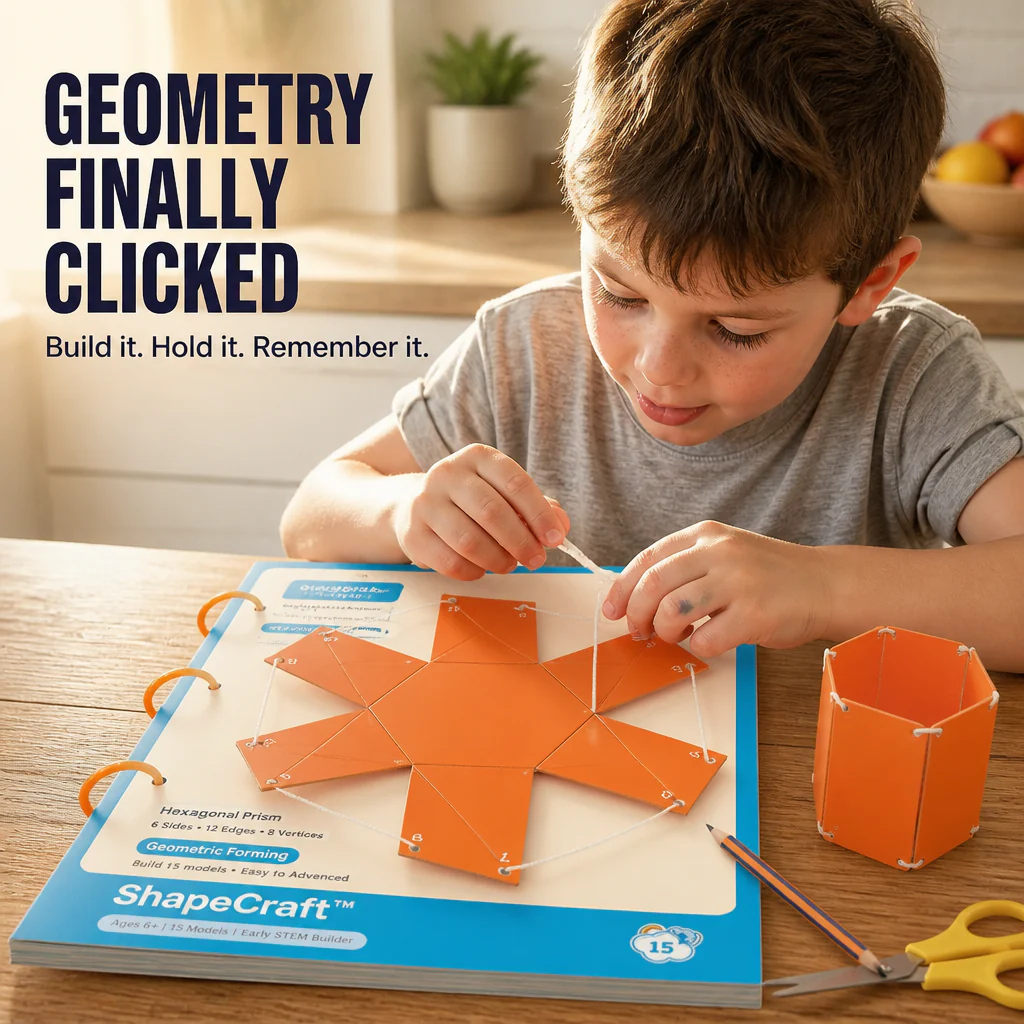
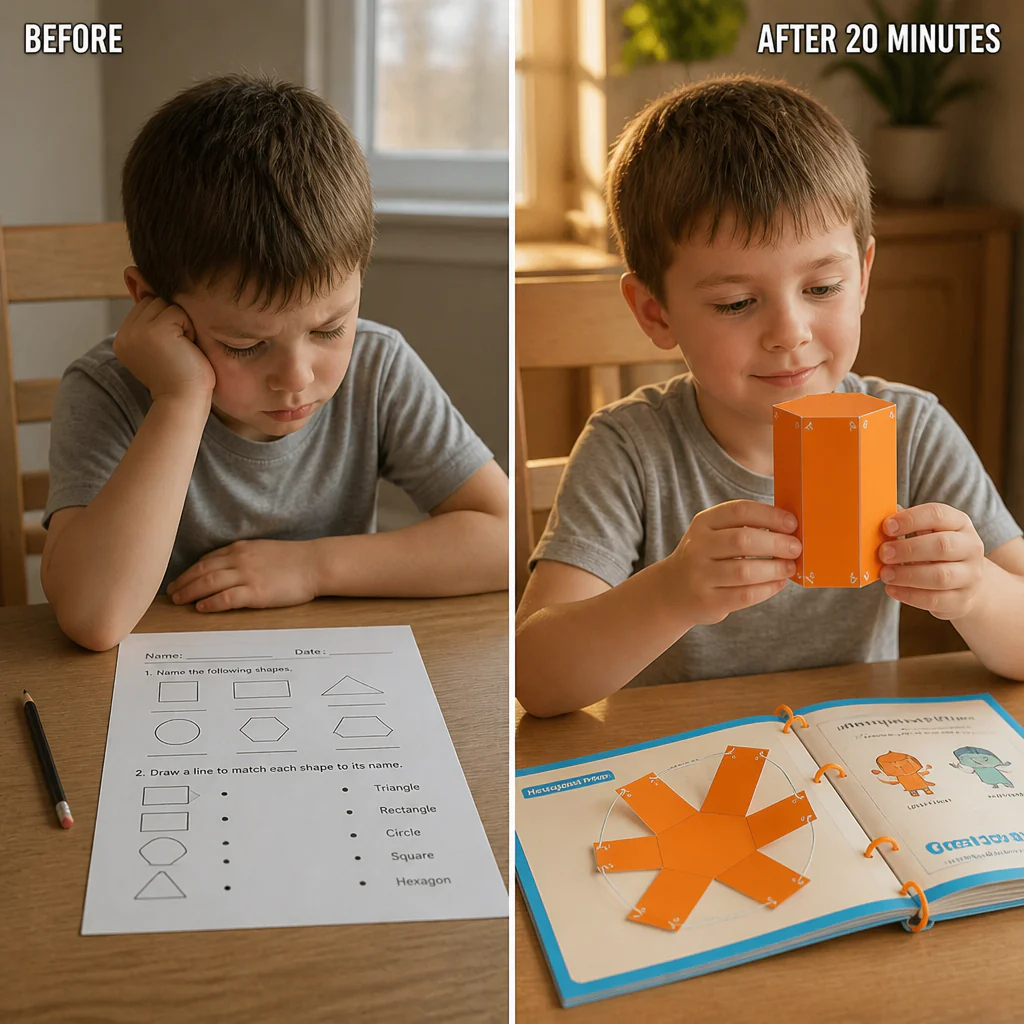
Your kid stares at a worksheet full of flat shapes and shuts down — same loop, every week. ShapeCraft™ swaps the textbook diagrams for numbered cardstock pieces they cut out, thread together with elastic, and build into real 3D solids. Twenty minutes in, they're holding a hexagonal prism they made themselves — and suddenly the shape on the next worksheet makes sense.

Stop Fighting The Geometry Worksheet — They Need To Touch It To Get It
Flat textbook diagrams ask a 7-year-old to imagine a 3D shape from a 2D picture, and most kids just can't bridge that yet. Apps add another screen to a day that's already screen-heavy. Drills punish the kid who's already struggling. None of this is your kid's fault — they're missing the step where the shape becomes real in their hands first.
➤ Makes the shape real in their hands: They cut, fold, and thread the pieces together — prism, pyramid, dodecahedron stop being mystery words and become things they built and can hold.
➤ Trades screen time for build time: Pencils, scissors, elastic, paper. Twenty to forty minutes of quiet focus that doesn't end in "five more minutes."
➤ Builds the patience math actually needs: Threading elastic through numbered holes in order teaches the same step-by-step focus geometry homework demands — disguised as a craft.

Introducing ShapeCraft™ — The Build-It-Yourself Geometry Book Kids Actually Finish
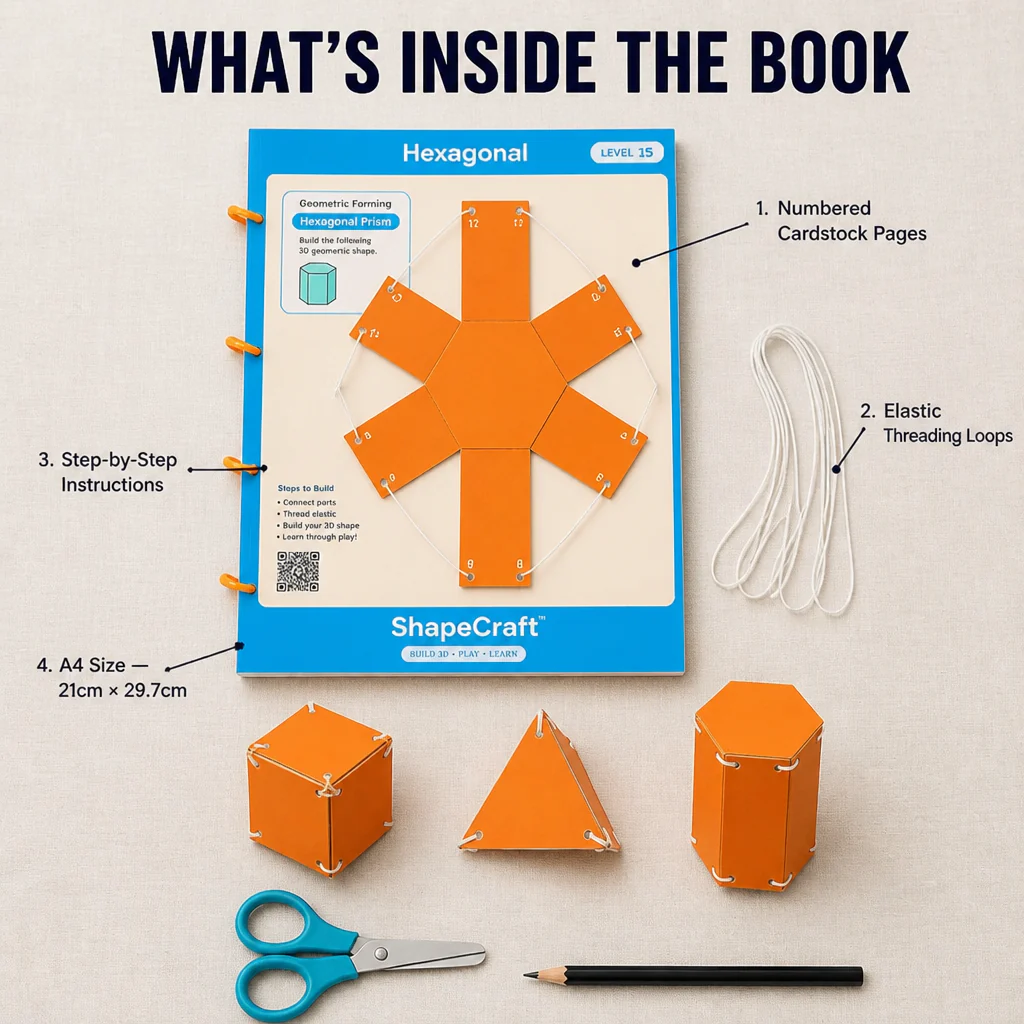
ShapeCraft™ is a bound A4 workbook with detachable cardstock pages. Each page is a different 3D shape pre-printed in net form — flat, numbered, and ready to cut. Kids snip along the outline, fold along the score lines, then thread the included elastic loops through numbered holes in sequence (1 to 2, 2 to 3, and so on) until the flat net pulls itself into a finished 3D solid sitting on their desk.
The numbered system means they can't really get it wrong. Thread 1 to 2 in order and the shape builds itself. That feeling — finishing a model that holds together — is what makes geometry stop feeling like punishment.

Why Parents Keep Reordering ShapeCraft™ For Younger Siblings
The pattern shows up review after review: the first model takes a parent's help, the second one the kid does alone, and by the fifth they're asking "what's the next shape?" on a Saturday morning. Same kids who used to push the math binder away. Sarah M. wrote in: "My 7-year-old has dyslexia and shuts down on worksheets. He did the hexagonal prism in one sitting and then asked me where the next book was. I almost cried." Renee B.: "I bought it for math but my son spent the whole weekend on it like it was Lego. He's showing his grandfather the shapes he built on FaceTime — he's never done that with homework."

What Your Kid Walks Away With After Every Build
✓ Geometry that finally sticks: A kid who's built a tetrahedron knows what a tetrahedron is — no flashcard required.
✓ Hands learn what brains forget: Cutting, folding, and threading sharpen fine motor skills the same way handwriting practice does — except it doesn't feel like practice.
✓ Twenty minutes that aren't a fight: Saturday mornings where you're not nagging about screens — they're just working on the next shape.
How ShapeCraft™ Works — Three Steps To A Finished 3D Shape
Step 1: Pick a shape from the workbook and cut along the printed outline — child-safe scissors handle the cardstock cleanly.
Step 2: Fold along the score lines and thread the elastic loops through the numbered holes in order. The numbers do the spatial thinking for them.
Step 3: Pull the elastic snug. The flat net lifts itself into a finished 3D shape they can hold, name, and show off.

| ShapeCraft™ | Math Apps | Worksheets & Drills |
|---|---|---|
| Builds a real 3D shape kids can hold and keep | ❌ | ❌ |
| Screen-free focus, 20–40 minutes per shape | ❌ | ❌ |
| Numbered build system — they can't get stuck | ❌ | ❌ |
Full Details For Careful Buyers
- Durable cardstock: Printed with non-toxic inks — safe for kids who still chew their pencils.
- A4 size (21cm × 29.7cm): Full-page templates sized for small hands to cut without trimming.
- Numbered build system: Every hole pairs with another by number, so kids self-correct without parent help.
- Ages 6 and up: Starts with simple cubes, scales up through pyramids, prisms, and dodecahedrons.
Got Questions? Here's What You Need To Know
Will my 6-year-old actually be able to do this without me sitting next to them?
The first shape usually needs a parent for the cutting part, but by shape three most kids 6+ are running the whole thing alone. The numbered holes do the spatial reasoning for them.
What's included — do I need scissors, glue, anything else?
The book includes pre-printed cardstock pages, elastic threading loops, and step-by-step instructions. You'll want child-safe scissors and a sharp pencil — that's it. No glue, no batteries, no subscription.
My older kid is 9 — will this seem too babyish?
The shapes scale up. The book starts with cubes and triangular pyramids and works toward dodecahedrons and truncated octahedrons — plenty of challenge for a 9-year-old who already knows the basics.
How long does one shape take from cut to finished?
Twenty minutes for a simple cube or pyramid, closer to forty for the complex polyhedra near the back. Most kids finish in one sitting if they slow down to do it carefully.
What happens when we've built every shape in the book?
The book has progressive shapes from simple cubes up through complex polyhedra. Most parents are reordering for younger siblings or a second copy by the time their kid's worked through them all.

Watch Homework Stop Being The Fight In Your House
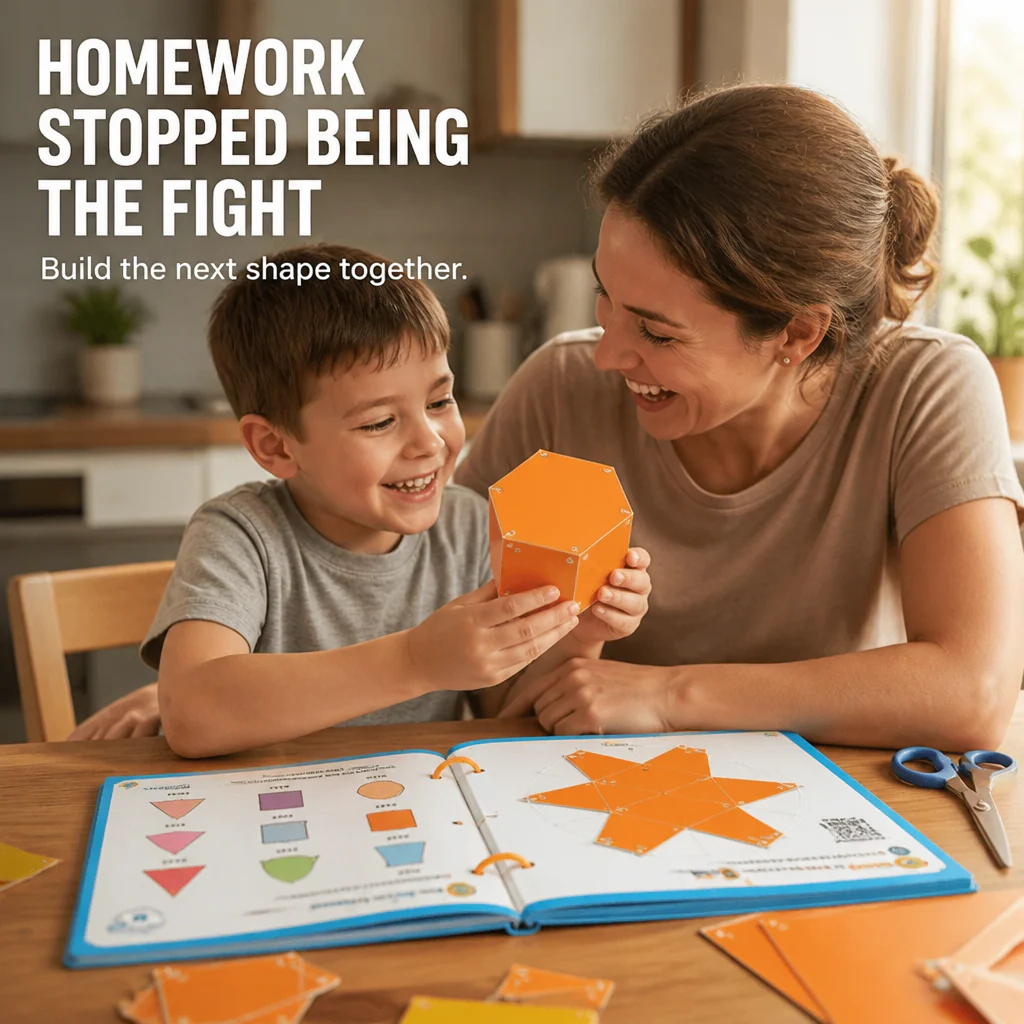
Most kids hit the first page expecting another worksheet. The first time they finish a shape they built with their own hands, the relationship with geometry quietly changes. If ShapeCraft™ doesn't pull your kid in within the first three shapes, send it back — we'll refund every dollar.
Original: $24.99
-70%$24.99
$7.50More Images



ShapeCraft™ — Build Real 3D Shapes And Make Geometry Finally Click For Kids 6+
Build Real 3D Shapes — Watch Geometry Click For Your 6+ Year Old
Your kid stares at a worksheet full of flat shapes and shuts down — same loop, every week. ShapeCraft™ swaps the textbook diagrams for numbered cardstock pieces they cut out, thread together with elastic, and build into real 3D solids. Twenty minutes in, they're holding a hexagonal prism they made themselves — and suddenly the shape on the next worksheet makes sense.
Stop Fighting The Geometry Worksheet — They Need To Touch It To Get It
Flat textbook diagrams ask a 7-year-old to imagine a 3D shape from a 2D picture, and most kids just can't bridge that yet. Apps add another screen to a day that's already screen-heavy. Drills punish the kid who's already struggling. None of this is your kid's fault — they're missing the step where the shape becomes real in their hands first.
➤ Makes the shape real in their hands: They cut, fold, and thread the pieces together — prism, pyramid, dodecahedron stop being mystery words and become things they built and can hold.
➤ Trades screen time for build time: Pencils, scissors, elastic, paper. Twenty to forty minutes of quiet focus that doesn't end in "five more minutes."
➤ Builds the patience math actually needs: Threading elastic through numbered holes in order teaches the same step-by-step focus geometry homework demands — disguised as a craft.
Introducing ShapeCraft™ — The Build-It-Yourself Geometry Book Kids Actually Finish
ShapeCraft™ is a bound A4 workbook with detachable cardstock pages. Each page is a different 3D shape pre-printed in net form — flat, numbered, and ready to cut. Kids snip along the outline, fold along the score lines, then thread the included elastic loops through numbered holes in sequence (1 to 2, 2 to 3, and so on) until the flat net pulls itself into a finished 3D solid sitting on their desk.
The numbered system means they can't really get it wrong. Thread 1 to 2 in order and the shape builds itself. That feeling — finishing a model that holds together — is what makes geometry stop feeling like punishment.
Why Parents Keep Reordering ShapeCraft™ For Younger Siblings
The pattern shows up review after review: the first model takes a parent's help, the second one the kid does alone, and by the fifth they're asking "what's the next shape?" on a Saturday morning. Same kids who used to push the math binder away. Sarah M. wrote in: "My 7-year-old has dyslexia and shuts down on worksheets. He did the hexagonal prism in one sitting and then asked me where the next book was. I almost cried." Renee B.: "I bought it for math but my son spent the whole weekend on it like it was Lego. He's showing his grandfather the shapes he built on FaceTime — he's never done that with homework."
What Your Kid Walks Away With After Every Build
✓ Geometry that finally sticks: A kid who's built a tetrahedron knows what a tetrahedron is — no flashcard required.
✓ Hands learn what brains forget: Cutting, folding, and threading sharpen fine motor skills the same way handwriting practice does — except it doesn't feel like practice.
✓ Twenty minutes that aren't a fight: Saturday mornings where you're not nagging about screens — they're just working on the next shape.
How ShapeCraft™ Works — Three Steps To A Finished 3D Shape
Step 1: Pick a shape from the workbook and cut along the printed outline — child-safe scissors handle the cardstock cleanly.
Step 2: Fold along the score lines and thread the elastic loops through the numbered holes in order. The numbers do the spatial thinking for them.
Step 3: Pull the elastic snug. The flat net lifts itself into a finished 3D shape they can hold, name, and show off.
| ShapeCraft™ | Math Apps | Worksheets & Drills |
|---|---|---|
| Builds a real 3D shape kids can hold and keep | ❌ | ❌ |
| Screen-free focus, 20–40 minutes per shape | ❌ | ❌ |
| Numbered build system — they can't get stuck | ❌ | ❌ |
Full Details For Careful Buyers
- Durable cardstock: Printed with non-toxic inks — safe for kids who still chew their pencils.
- A4 size (21cm × 29.7cm): Full-page templates sized for small hands to cut without trimming.
- Numbered build system: Every hole pairs with another by number, so kids self-correct without parent help.
- Ages 6 and up: Starts with simple cubes, scales up through pyramids, prisms, and dodecahedrons.
Got Questions? Here's What You Need To Know
Will my 6-year-old actually be able to do this without me sitting next to them?
The first shape usually needs a parent for the cutting part, but by shape three most kids 6+ are running the whole thing alone. The numbered holes do the spatial reasoning for them.
What's included — do I need scissors, glue, anything else?
The book includes pre-printed cardstock pages, elastic threading loops, and step-by-step instructions. You'll want child-safe scissors and a sharp pencil — that's it. No glue, no batteries, no subscription.
My older kid is 9 — will this seem too babyish?
The shapes scale up. The book starts with cubes and triangular pyramids and works toward dodecahedrons and truncated octahedrons — plenty of challenge for a 9-year-old who already knows the basics.
How long does one shape take from cut to finished?
Twenty minutes for a simple cube or pyramid, closer to forty for the complex polyhedra near the back. Most kids finish in one sitting if they slow down to do it carefully.
What happens when we've built every shape in the book?
The book has progressive shapes from simple cubes up through complex polyhedra. Most parents are reordering for younger siblings or a second copy by the time their kid's worked through them all.
Watch Homework Stop Being The Fight In Your House
Most kids hit the first page expecting another worksheet. The first time they finish a shape they built with their own hands, the relationship with geometry quietly changes. If ShapeCraft™ doesn't pull your kid in within the first three shapes, send it back — we'll refund every dollar.
Product Information
Product Information
Shipping & Returns
Shipping & Returns
Description
Build Real 3D Shapes — Watch Geometry Click For Your 6+ Year Old
Your kid stares at a worksheet full of flat shapes and shuts down — same loop, every week. ShapeCraft™ swaps the textbook diagrams for numbered cardstock pieces they cut out, thread together with elastic, and build into real 3D solids. Twenty minutes in, they're holding a hexagonal prism they made themselves — and suddenly the shape on the next worksheet makes sense.
Stop Fighting The Geometry Worksheet — They Need To Touch It To Get It
Flat textbook diagrams ask a 7-year-old to imagine a 3D shape from a 2D picture, and most kids just can't bridge that yet. Apps add another screen to a day that's already screen-heavy. Drills punish the kid who's already struggling. None of this is your kid's fault — they're missing the step where the shape becomes real in their hands first.
➤ Makes the shape real in their hands: They cut, fold, and thread the pieces together — prism, pyramid, dodecahedron stop being mystery words and become things they built and can hold.
➤ Trades screen time for build time: Pencils, scissors, elastic, paper. Twenty to forty minutes of quiet focus that doesn't end in "five more minutes."
➤ Builds the patience math actually needs: Threading elastic through numbered holes in order teaches the same step-by-step focus geometry homework demands — disguised as a craft.
Introducing ShapeCraft™ — The Build-It-Yourself Geometry Book Kids Actually Finish
ShapeCraft™ is a bound A4 workbook with detachable cardstock pages. Each page is a different 3D shape pre-printed in net form — flat, numbered, and ready to cut. Kids snip along the outline, fold along the score lines, then thread the included elastic loops through numbered holes in sequence (1 to 2, 2 to 3, and so on) until the flat net pulls itself into a finished 3D solid sitting on their desk.
The numbered system means they can't really get it wrong. Thread 1 to 2 in order and the shape builds itself. That feeling — finishing a model that holds together — is what makes geometry stop feeling like punishment.
Why Parents Keep Reordering ShapeCraft™ For Younger Siblings
The pattern shows up review after review: the first model takes a parent's help, the second one the kid does alone, and by the fifth they're asking "what's the next shape?" on a Saturday morning. Same kids who used to push the math binder away. Sarah M. wrote in: "My 7-year-old has dyslexia and shuts down on worksheets. He did the hexagonal prism in one sitting and then asked me where the next book was. I almost cried." Renee B.: "I bought it for math but my son spent the whole weekend on it like it was Lego. He's showing his grandfather the shapes he built on FaceTime — he's never done that with homework."
What Your Kid Walks Away With After Every Build
✓ Geometry that finally sticks: A kid who's built a tetrahedron knows what a tetrahedron is — no flashcard required.
✓ Hands learn what brains forget: Cutting, folding, and threading sharpen fine motor skills the same way handwriting practice does — except it doesn't feel like practice.
✓ Twenty minutes that aren't a fight: Saturday mornings where you're not nagging about screens — they're just working on the next shape.
How ShapeCraft™ Works — Three Steps To A Finished 3D Shape
Step 1: Pick a shape from the workbook and cut along the printed outline — child-safe scissors handle the cardstock cleanly.
Step 2: Fold along the score lines and thread the elastic loops through the numbered holes in order. The numbers do the spatial thinking for them.
Step 3: Pull the elastic snug. The flat net lifts itself into a finished 3D shape they can hold, name, and show off.
| ShapeCraft™ | Math Apps | Worksheets & Drills |
|---|---|---|
| Builds a real 3D shape kids can hold and keep | ❌ | ❌ |
| Screen-free focus, 20–40 minutes per shape | ❌ | ❌ |
| Numbered build system — they can't get stuck | ❌ | ❌ |
Full Details For Careful Buyers
- Durable cardstock: Printed with non-toxic inks — safe for kids who still chew their pencils.
- A4 size (21cm × 29.7cm): Full-page templates sized for small hands to cut without trimming.
- Numbered build system: Every hole pairs with another by number, so kids self-correct without parent help.
- Ages 6 and up: Starts with simple cubes, scales up through pyramids, prisms, and dodecahedrons.
Got Questions? Here's What You Need To Know
Will my 6-year-old actually be able to do this without me sitting next to them?
The first shape usually needs a parent for the cutting part, but by shape three most kids 6+ are running the whole thing alone. The numbered holes do the spatial reasoning for them.
What's included — do I need scissors, glue, anything else?
The book includes pre-printed cardstock pages, elastic threading loops, and step-by-step instructions. You'll want child-safe scissors and a sharp pencil — that's it. No glue, no batteries, no subscription.
My older kid is 9 — will this seem too babyish?
The shapes scale up. The book starts with cubes and triangular pyramids and works toward dodecahedrons and truncated octahedrons — plenty of challenge for a 9-year-old who already knows the basics.
How long does one shape take from cut to finished?
Twenty minutes for a simple cube or pyramid, closer to forty for the complex polyhedra near the back. Most kids finish in one sitting if they slow down to do it carefully.
What happens when we've built every shape in the book?
The book has progressive shapes from simple cubes up through complex polyhedra. Most parents are reordering for younger siblings or a second copy by the time their kid's worked through them all.
Watch Homework Stop Being The Fight In Your House
Most kids hit the first page expecting another worksheet. The first time they finish a shape they built with their own hands, the relationship with geometry quietly changes. If ShapeCraft™ doesn't pull your kid in within the first three shapes, send it back — we'll refund every dollar.